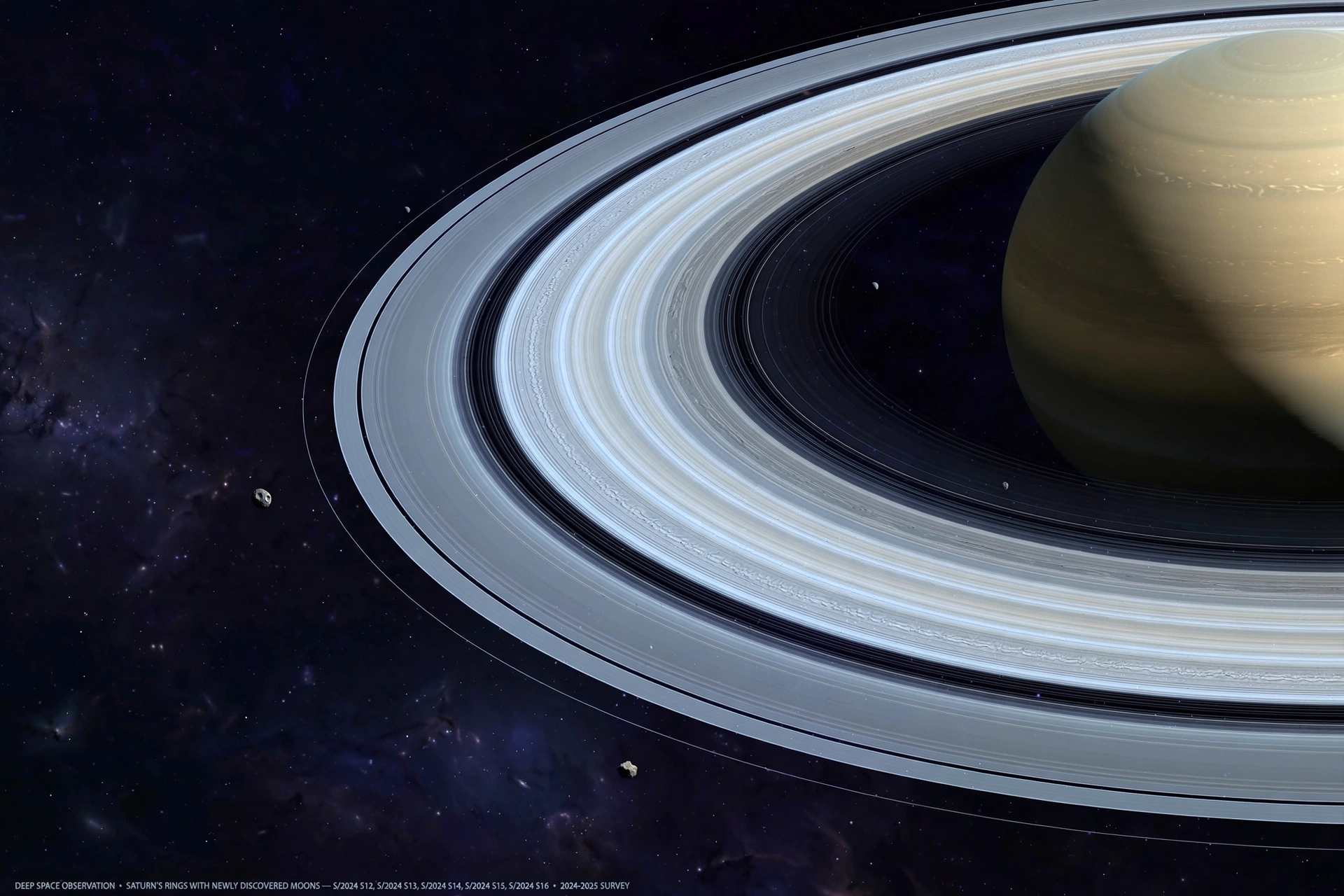
Tracking 128 Hidden Moons: The Telescope Trick That Found Saturn’s Crowd
Every few years, a software technique quietly outperforms a bigger telescope. Saturn’s latest moon haul is a case in point. Astronomers have confirmed 128 new moons of the ringed planet, taking its official total from 146 to 274, more than all the other planets combined. The objects themselves are small and faint. The interesting technology story is how anyone managed to detect them at all.
Readers who followed our explainer on how 3D DNA architecture may explain the octopus brain will recognise the pattern: a hard measurement problem, solved by combining lots of weak signals into one strong conclusion. Saturn’s new moons were found the same way, except the signals were pixels collected over several years on a mountaintop in Hawaii.
The instrument and the team
The observations came from the Canada-France-Hawaii Telescope on Mauna Kea, a 3.6-metre telescope whose wide-field camera can record a large patch of sky in fine detail. The research group included scientists from the University of British Columbia, among them Dr Edward Ashton, working with colleagues who specialise in the outer solar system. Their target area was the space around Saturn where a small moon’s reflected sunlight is overwhelmed by glare, distance and background stars.
Finding an object once is not enough. To prove a faint speck belongs to Saturn, astronomers must observe it repeatedly, fit an orbit, and show that the orbit is bound to the planet. The confirmed list was then recognised by the International Astronomical Union, which maintains the official record. That administrative step is what turned a research catalogue into the new headline figure of 274.
Shift and stack, step by step
The core technique is called shift and stack, and it is elegantly simple. A moon of Saturn moves slowly against the distant stars. If you take dozens of long exposures and add them together at exactly the rate and direction the moon is expected to move, the moon’s faint light lands on the same pixels every time and builds into a visible dot. Stars, moving at a different apparent rate, smear and fade into the background. The CFHT site outlines the observatory’s wide-field imaging work that makes this kind of survey practical.
The catch is that you must test many possible rates and directions, because each moon’s orbit differs. That turns the search into a computing problem as much as an observing one: image sets gathered over several years are reprocessed systematically until real objects separate from noise, cosmic rays and image defects. Every candidate then needs follow-up tracking, which is why confirmation arrives years after the first photons were collected.
What kind of moons are these?
Almost all of the 128 are irregular moons. They are only a few kilometres wide, orbit far from Saturn, and follow tilted, elongated paths. Many travel retrograde, against the direction of Saturn’s spin. Regular moons, formed from the disc of material around the young planet, orbit close in and in an orderly fashion. Irregular moons look instead like asteroids or comet-like bodies that were captured later by Saturn’s gravity, a history written directly into their awkward orbits.
Groups of the new moons share similar orbital angles and distances, which strongly suggests they are fragments of a smaller number of larger captured bodies that were shattered by collisions. Each cluster is, in effect, debris with a family tree. Sorting the fragments helps astronomers estimate how many parent bodies Saturn captured and when the break-ups that scattered them are likely to have happened.
Why the count jumped so sharply
Nothing about Saturn changed; our detection threshold did. Earlier surveys missed kilometre-scale objects at those distances because individual images were too shallow. Shift and stack lowers the threshold by combining images, and modern processing makes it feasible to search the resulting data thoroughly. The jump from 146 to 274 therefore reflects instrument sensitivity, computing power and persistence, as much as it reflects the planet itself.
That also means 274 is unlikely to be the final number. Smaller fragments, below today’s threshold, should exist in large numbers, and future surveys will pick off the brighter end of that population. For now, though, the verified picture is striking enough: one planet, 274 recognised moons, and a discovery pipeline built on stacked images, careful orbit fitting and formal confirmation. The moons were always there. The technology finally caught up with them.