NeoVax Meets Nivolumab: Inside a Personalised Vaccine’s First Ovarian Cancer Trial
Personalised medicine is often described in futuristic terms, but its real test is logistical: can you sequence one patient’s tumour, design a product for that patient alone, manufacture it to clinical standard, and deliver it in time to matter? A phase 1 trial of the NeoVax vaccine, combined with nivolumab and published in Nature Medicine, put exactly that pipeline to the test in platinum-sensitive recurrent ovarian cancer.
The results need precise language. The study showed the vaccines could be manufactured and given, that safety was acceptable in this small group, and that T-cell responses were seen. It did not show that the combination cures ovarian cancer or improves survival, and it was not designed to. For readers who like the technical layer first, as in our piece on what Americans have actually saved by 50, here is what the trial’s machinery involved.
From tumour sample to bespoke vaccine
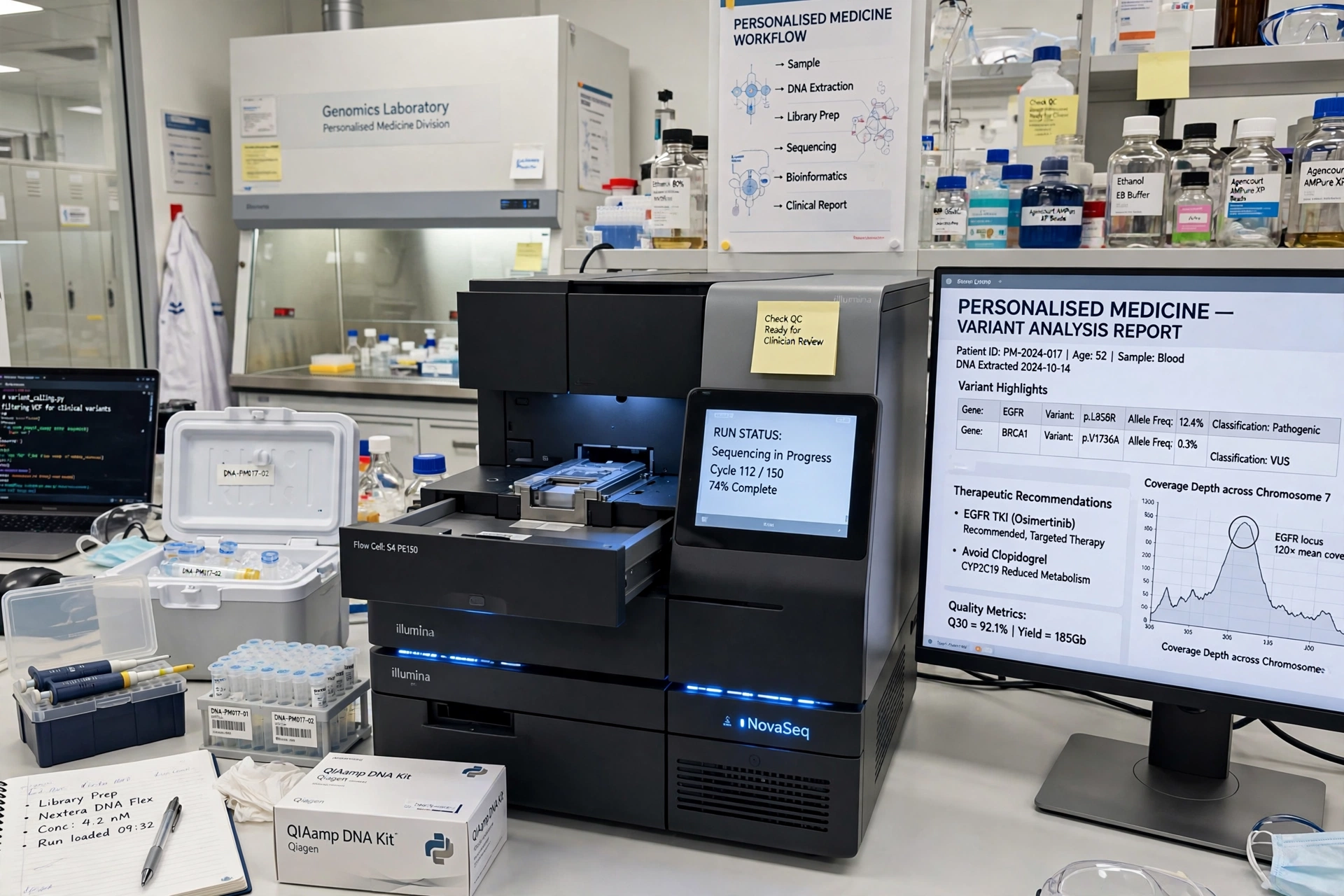
NeoVax begins with the mutations in an individual tumour. Cancer cells carry genetic errors that can produce abnormal protein fragments, known as neoantigens, which the immune system can in principle recognise as foreign. By sequencing tumour DNA and comparing it with the patient’s normal DNA, researchers select neoantigens likely to be presented to immune cells, then manufacture a vaccine containing those personalised targets. No two patients receive the same product, because no two tumours carry the same set of mutations.
That workflow depends on prediction software as much as on laboratory work. Choosing which neoantigens to include is a ranking problem: many candidate mutations exist, only some will be displayed on the cell surface, and only some of those will provoke a useful T-cell response. The trial therefore tested a chain of technologies at once, from biopsy handling and sequencing to selection algorithms, small-batch manufacturing and quality control. Background on neoantigen vaccine research is available from Dana-Farber Cancer Institute, where much of this approach was developed.
Why add nivolumab?
Nivolumab is a PD-1 immune checkpoint inhibitor. Some tumours exploit the PD-1 pathway to damp down attacking T cells; blocking that checkpoint can restore immune activity. Pairing it with NeoVax follows a clear logic: the vaccine aims to create or expand T cells that recognise tumour neoantigens, and the checkpoint inhibitor aims to keep those cells active in an environment that would otherwise suppress them.
Logic, however, is not evidence of benefit. In a small, single-arm phase 1 study, patients receive the combination and are monitored; there is no comparison group receiving nivolumab alone or another treatment. That design can answer feasibility and safety questions and can detect immune responses in blood samples, which this study reported. It cannot tell us how much, if anything, the vaccine added. Reporting from Nature Medicine should be read with that design firmly in mind.
Reading the endpoints like an engineer
Think of the trial’s endpoints as staged tests. Test one: can a vaccine be produced for enrolled patients at all? Personalised manufacturing can fail at sequencing, design or production, so a completed delivery is a real result. Test two: is the combination tolerable enough to study further? Safety was reported as acceptable, which clears that gate while leaving rarer risks unmeasured in a group this small. Test three: does the immune system respond? T-cell responses against vaccine neoantigens were observed, suggesting the biological mechanism engaged as intended.
Notice what is missing from that list, deliberately: proof that tumours shrank because of the vaccine, that recurrence was delayed, or that patients lived longer. Those are the endpoints of later, larger, controlled trials. Skipping ahead in interpretation is the most common error in coverage of early oncology results, and this study is a good example of why the staging exists.
The road from feasibility to a real option
For the approach to become a genuine option in recurrent ovarian cancer, several things must happen together. Manufacturing must get faster and cheaper, because a bespoke product for every patient is expensive by design. Selection algorithms must improve so that vaccine slots are spent on the neoantigens most likely to drive useful responses. And a randomised trial must show a clinical advantage worth the cost and complexity, in a disease where recurrence is common and time matters to patients.
None of that diminishes what this phase 1 study did. It demonstrated, in a demanding clinical setting, that a fully personalised neoantigen vaccine could be built and administered alongside a checkpoint inhibitor, with acceptable safety and visible immune responses. That is the foundation everything else would have to stand on, and it is the accurate headline: feasibility shown, efficacy still to be proven.