
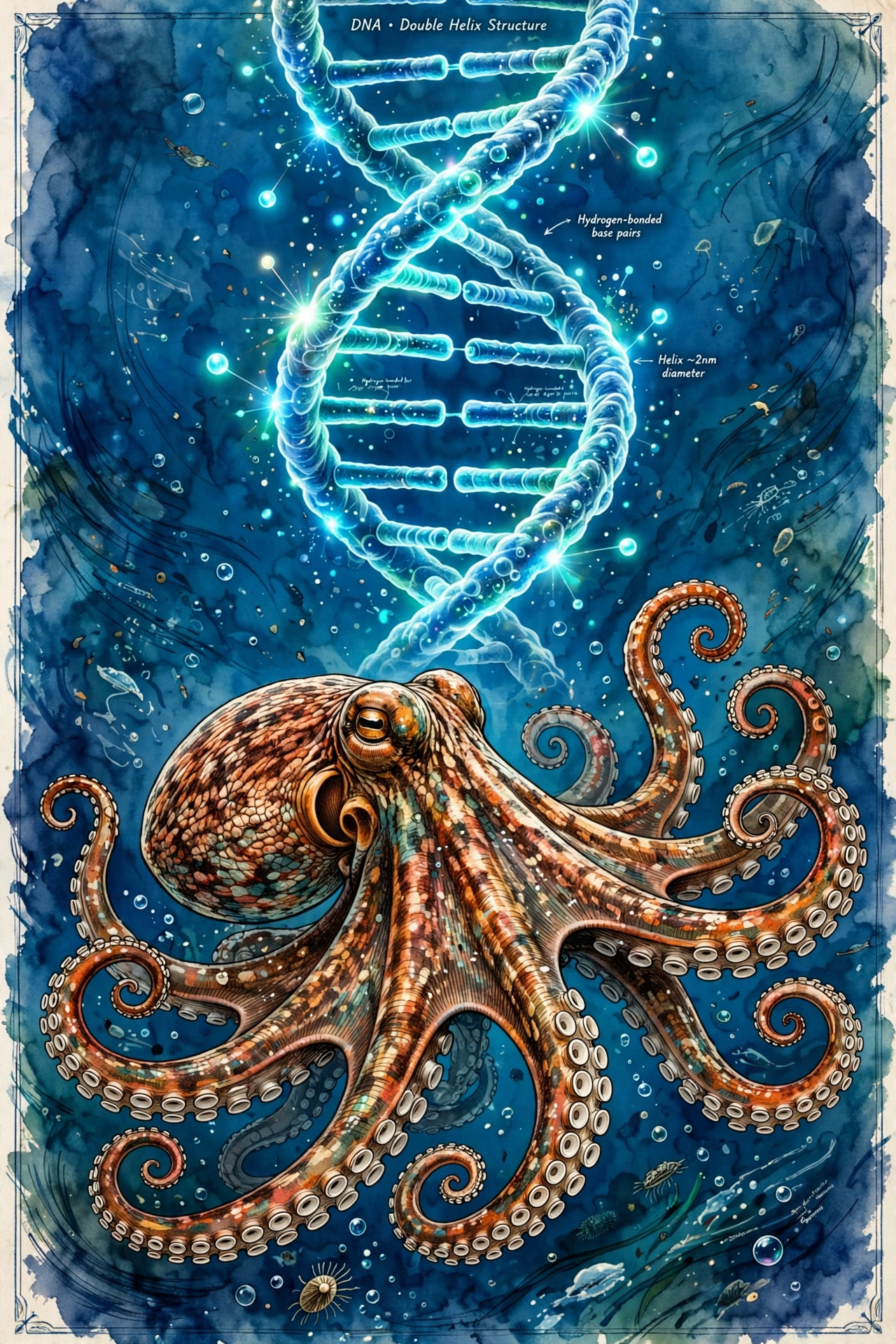
How 3D DNA Architecture May Explain the Octopus’s Remarkable Brain
Octopuses can unscrew jars, navigate mazes, recognise individual people and change the colour and texture of their skin in a fraction of a second. For an animal only distantly related to humans, that level of intelligence has long puzzled biologists. New research from the University of Vienna now suggests part of the answer may lie not in which genes cephalopods have, but in how their DNA is folded in three dimensions inside the cell.
The study, reported by the University of Vienna, examined how the genome is organised in cephalopods — the group that includes octopuses, squid and cuttlefish. The researchers found unusual patterns of 3D genome architecture that may have helped these animals evolve large, complex nervous systems independently from vertebrates.
More Than a String of Letters
DNA is often described as a code, a long string of letters spelling out genes. Inside a living cell, however, that string is not laid out flat. It is folded, looped and packed into the nucleus in precise ways. Which parts of the genome touch each other in 3D space can determine which genes are switched on, which stay silent, and how strongly a gene is expressed in a particular cell type, such as a neuron.
That folding matters especially in the brain. A neuron and a skin cell carry the same DNA, yet they behave completely differently because different gene programmes are active. Changes in 3D architecture can therefore rewire development without inventing entirely new genes — a powerful route for evolution to build complexity quickly.
For readers following our wider science and technology coverage on TechKap, the finding fits a growing theme: biology is discovering that information in the genome is stored not only in sequence, but also in shape.
An Independent Route to a Complex Brain
Cephalopods split from the lineage that led to humans more than 500 million years ago. Their last common ancestor was a far simpler creature, probably with a modest nervous system. Yet octopuses and their relatives went on to evolve camera-like eyes, large brains relative to body size, and sophisticated learning and memory — a striking case of convergent evolution.
The Vienna work suggests that rearrangements in genome folding may have brought distant regulatory elements next to genes involved in nervous system development. When a regulatory switch that normally sits far away is folded close to a brain gene, that gene can be activated in new places, at new times, or at higher levels. Over millions of years, many such changes could help assemble a more elaborate brain.
Researchers are particularly interested in this mechanism because cephalopods are also famous for extensive RNA editing, another unusual way they diversify the proteins their nervous systems can make. Together, genome architecture and RNA editing paint a picture of animals that evolved intelligence using a molecular toolkit quite different from our own.
Why Octopus Intelligence Matters Beyond Biology
Understanding how a complex brain can be built a second, independent way has implications far beyond marine biology. For neuroscience, it offers a natural comparison: which features of brain organisation are truly necessary for learning and problem-solving, and which are historical accidents of vertebrate evolution?
For technology, cephalopods already inspire soft robotics, adaptive camouflage materials and distributed control systems — an octopus arm contains a large share of the animal’s neurons and can act with considerable autonomy. A deeper genetic explanation for that distributed intelligence could inform how engineers design systems that sense and respond without centralising every decision.
There are also conservation and welfare questions. As evidence for cephalopod cognition grows, so does debate about how these animals should be treated in research, aquaculture and fisheries. Genetic work that underlines just how distinct their evolutionary path has been is likely to add weight to that discussion.
What Comes Next
The findings do not claim that a single fold in DNA created the octopus brain. Evolution rarely works through one change. Instead, the research identifies a plausible and previously underappreciated layer of change — 3D genome organisation — that may have accelerated or enabled many smaller steps along the way.
Next steps for the field include comparing genome folding across several cephalopod species, from highly intelligent octopuses to more solitary or deep-sea relatives, and testing in the laboratory whether altering a specific fold changes how a brain-related gene behaves during development. Advances in chromosome conformation capture and single-cell sequencing are making those experiments increasingly feasible.
What is already clear is that the octopus did not become clever by copying vertebrates. It found another path, written partly in the way its DNA bends and loops in three dimensions. Studying that alternative blueprint may ultimately tell us as much about the rules of intelligence itself as it does about life in the ocean.


